
Even the newest hype, AI agents, quietly run on one. At MQ Summit on October 21, I opened my talk with that thought. Here’s the longer version. Link to the talk is coming soon!
When did you last read a hype post about queues?
I honestly can’t remember. Maybe 2016? Since then, the industry has fallen in love with frontend frameworks, microservices, serverless, and now AI agents. Each one got its conference keynotes, its manifestos, and its “X is dead” posts.
Message queues got none of that. They’ve been infrastructure’s quiet part for a decade, running in the background while everything above them changed.
And yet, every one of those architectures leans on a queue somewhere. Microservices need a way to communicate without waiting on each other. Serverless functions need something to trigger them. AI agents need somewhere to put work that takes longer than a single request.
That’s the paradox. The more invisible the job, the harder it is to get credit for doing it well. Kind of like pipes: nobody talks about them until the toilet backs up.
What 14 years of hosting brokers taught us
At CloudAMQP, we’ve spent the last 14 years hosting message brokers like RabbitMQ and LavinMQ for thousands of companies worldwide. And that “worldwide” part matters. When your customers are on every continent, it’s always a normal working day for someone.
The broker doesn’t care what time it is. The customer doesn’t care either. If something ever goes wrong, someone needs to be there, even when it’s 2 a.m. for you. That’s why we’ve spread our team across time zones, on purpose. Someone is always awake.
But here’s what 14 years have taught me: most nights, nothing happens. That’s the job. Nobody notices a queue that works, and for us, the best night is the one nobody remembers.
What we learned building an AI agent
We saw this up close when we built 84bot, our internal Slack agent. Our first version was simple and synchronous: Slack sent a request to our server, the server called the AI model and waited for the answer.
It worked, until it didn’t. AI calls are slow and unpredictable, and Slack doesn’t like waiting.
So we put LavinMQ in the middle. Slack drops a message in a queue and gets an answer right away. Workers pick up the jobs at their own pace. Messages that fail don’t vanish; they land in their own queue, where we can look at them.
Then the queues started doing more than we planned for. We split work into separate queues for PagerDuty alerts, GitHub tasks, and coding jobs, so a slow job never blocks an urgent one. When the agent needs a human to approve something, the request waits in a queue like a letter in a mailbox until someone says yes.
None of this was new technology. It was the same queue that’s been quietly running in the background for years. It just turned out to be exactly what an AI agent needs.
The best infrastructure is the one you forget
Hype is useful. It gets people excited and moves the industry forward. But the infrastructure you depend on shouldn’t be exciting. It should be the part you forget you’re running.
So if nobody on your team talks about your message queue, take it as a compliment. It means it’s doing its job.
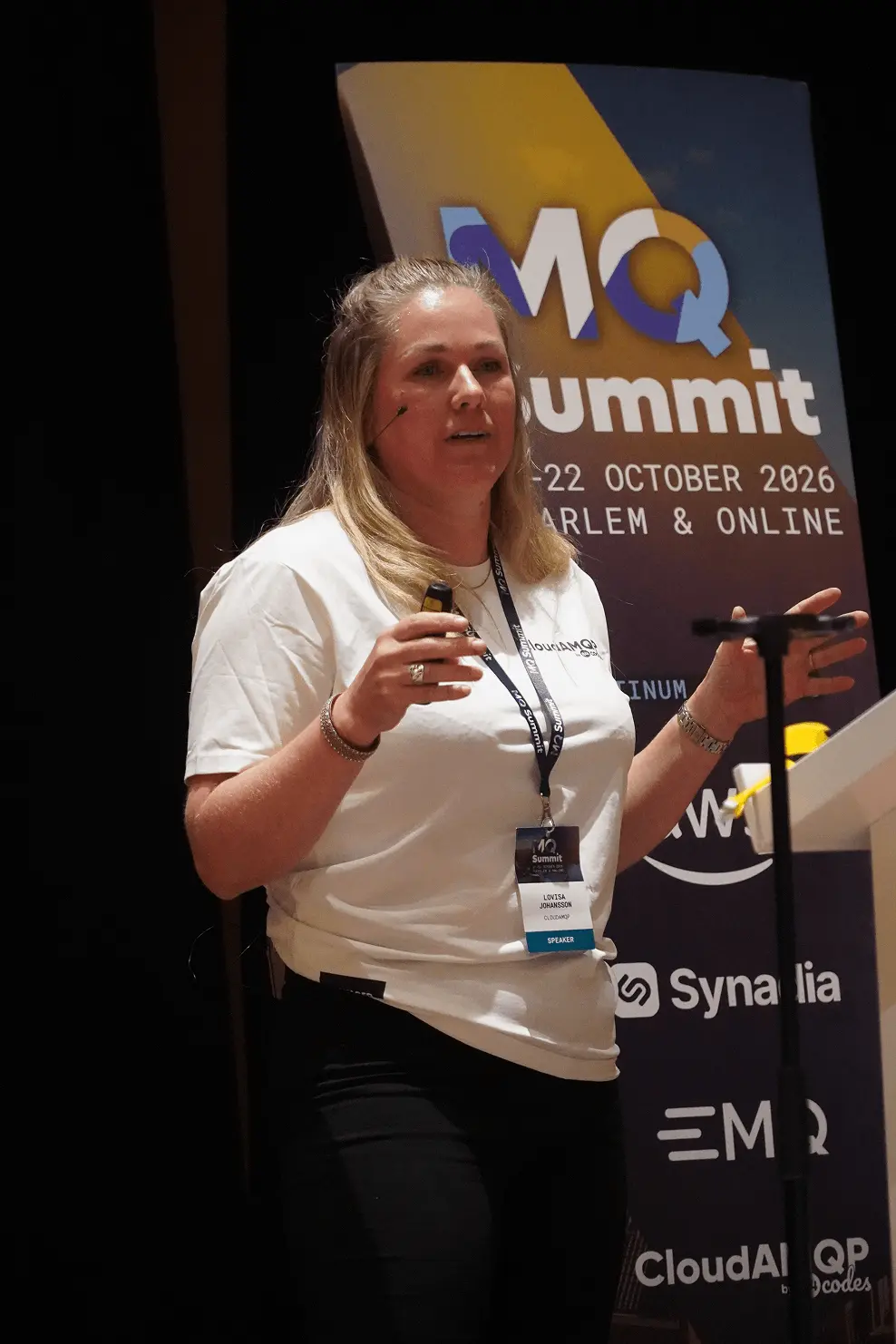 Lovisa during her talk at the MQ Summit in Haarlem, The Netherlands.
 Lovisa Johansson