"We weren't unhappy with RabbitMQ. But our workload had become so specific that we wanted a broker optimized for exactly that: high throughput with minimal footprint." That's how one engineer described his team's decision to me earlier this year, and it's stayed with me because I've heard some version of it from a lot of customers lately.
As a Customer Success Manager at 84codes, I spend most of my days talking to engineering teams about their messaging infrastructure, and over the past year, one conversation has kept coming up: what it's actually like to migrate from RabbitMQ to LavinMQ. I've now walked enough teams through it to have a real feel for how it goes, and that's what I want to share, especially if you're weighing the same decision.
Most of the teams I talk to have a lot of respect for RabbitMQ. It's a mature, battle-tested technology that has powered messaging infrastructure at companies of all sizes for many years, and for good reason. What I hear most often isn't frustration with RabbitMQ itself. It's more of a tension that comes with growth. As workloads scale, teams find themselves spending more time on infrastructure management than they planned. Including tuning, monitoring and keeping up with demand. This gradually pulls engineering attention away from building the product.
For many teams, that's the moment they move from self-hosting RabbitMQ to a managed setup on CloudAMQP, and increasingly, it's also when LavinMQ enters the conversation.
Is it worth moving to LavinMQ from such a proven standard?
The first question I always get is: "Is this actually worth the risk?" Switching your message broker in production feels like a big deal. And honestly, that skepticism is healthy. But what I walk customers through is why LavinMQ is a genuinely low-risk option, and it comes down to a few key things.
- LavinMQ is fully AMQP 0.9.1 compatible, the same protocol RabbitMQ uses. That means no changes to client libraries, no rewriting producers or consumers. For most teams, the migration is literally a one-line connection string change.
- LavinMQ's resource efficiency is remarkable. It is built in Crystal and handles memory differently: messages are written directly to disk, and OS-level caching takes it from there. Enqueueing 10 million messages uses roughly 80 MB of RAM. Handling 8,000 connections takes around 400 MB. Those numbers start to look interesting when you're trying to right-size your infrastructure.
- And then there's cost. Several customers have been upfront with me that cost reduction was the main reason they looked at LavinMQ at all, and they ended up on smaller instance sizes with better performance than they had before.
What migration actually looks like
This is where people tend to relax a bit. The migration process built into the CloudAMQP console is simple: from your existing RabbitMQ cluster, go to Edit, select Migrate to LavinMQ, choose your new plan, and confirm.
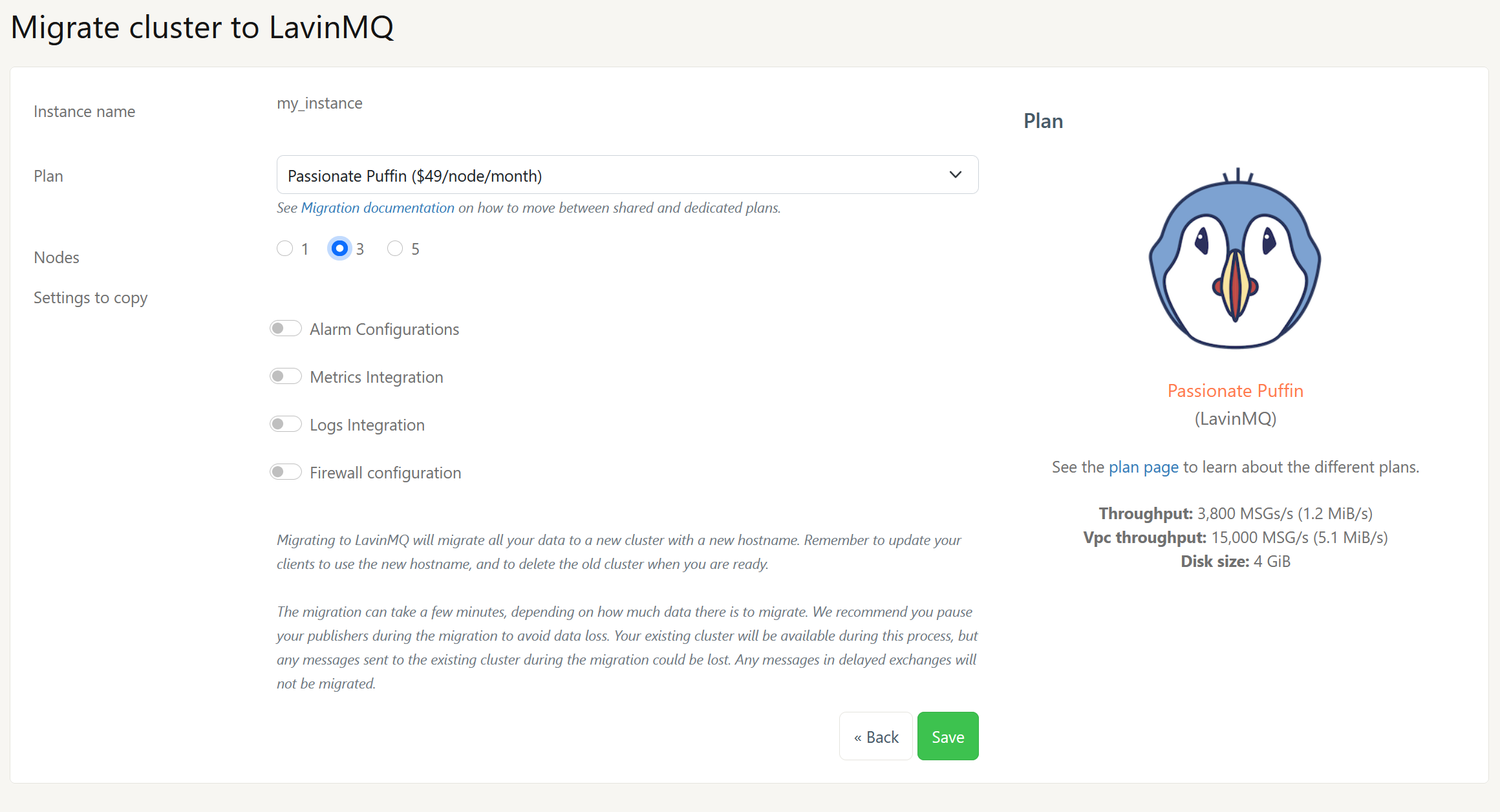
Behind the scenes, the platform exports your full cluster configuration (exchanges, queues, bindings, users, virtual hosts, permissions) and imports everything into the new LavinMQ cluster. Shovels handle live message migration between the two. Your original RabbitMQ cluster stays fully live throughout. No forced downtime.
The one thing I always recommend is briefly pausing publishers during the final cutover, just to ensure data consistency. There are a couple of edge cases worth knowing about: delayed messages that haven't landed in a queue yet can't be migrated mid-flight, and dead-lettered messages will have their TTL reset on arrival. For most teams, those are minor footnotes. Most of my customers get through it over a weekend, and more than a few have said they expected it to be harder.
After the migration
A month in, the feedback is almost always the same: the infrastructure overhead became more predictable. They're running on smaller and cheaper instances, and they're getting equal or better throughput out of them. Engineering time spent on tuning or monitoring is going somewhere else now. And nobody had to change their application code. Same AMQP client libraries, same queue declarations, same routing topology. The broker changed; their system didn't.
Advice for teams on the fence?
If you're running RabbitMQ on CloudAMQP and it's meeting all your needs, I'm not here to tell you to change a thing. It's a world-class broker for a reason.
But as systems scale, the question shifts from "does it work?" to "how efficiently does it run?". If your scale is starting to strain your hardware budget, or you just want more throughput per byte of RAM, LavinMQ is worth looking at. And since your original cluster stays untouched until you're ready to switch, you always have a way back.
If you want to talk through whether LavinMQ makes sense for your workload, reach out. And if you're ready to try it yourself, you can start a free LavinMQ instance on CloudAMQP today or kick off a test migration directly from your console.
Best, Jeff Hara

Jeff Hara
Customer Success Manager
Hi, I'm Jeff, and I'm here to help
Curious what LavinMQ can do for your architecture?
Reach out and let me showcase LavinMQ for you - I'd be happy to demonstrate its features, discuss your specific use cases, and explore how it can integrate with your existing systems.
Contact us today