
When to implement asynchronous messaging in distributed systems
Early in an infrastructure journey, a message broker is often not required. When systems have loose coupling and fewer dependencies, synchronous communication is often enough. Simplicity usually wins. Fewer components mean fewer things to maintain and reason about.
This post reflects on when asynchronous messaging starts to matter, and what tends to change once systems move away from waiting on each other.
That shift away from waiting is how I think about asynchronous messaging: letting systems hand off work and continue, instead of waiting for each other to respond.
As systems grow, that shift starts to matter more.
Over time, complexity grows naturally. As traffic increases and responsibilities are split across services, coordination becomes harder. This is often when asynchronous messaging starts to make sense. Adding a broker introduces some overhead, but it also helps manage a much larger form of complexity.
In practice, adding messaging early often feels simpler, but that doesn’t mean it’s a missed opportunity if you didn’t. Many teams introduce a broker later in their system’s life and still see great results.
Message queues have proven useful across many industries for handling asynchronous workloads, isolating failures, and reducing coupling between services. The use cases vary, but the underlying challenges are often similar. At CloudAMQP, working closely with RabbitMQ and LavinMQ over the years has shown how much a well-designed messaging layer can make a difference.
In many systems, this stage of growth is where request–response communication starts to feel limiting. Each service depends on the next one responding in time, and delays or failures can quickly spread through the system. At that stage, the question becomes how to move toward asynchronous messaging in practice.
Implementing asynchronous messaging
Deciding to introduce messaging is usually the result of earlier pressure in the system. Once that decision is made, implementation rarely starts with technology. It starts with identifying work that does not need an immediate response.
Background tasks, deferred processing, and work that can happen independently of a user request are often good candidates. These are typically the first places where asynchronous messaging fits naturally.
Introducing a message broker creates a more precise boundary between services. Instead of waiting for another system to respond, a service hands off work and continues. This reduces tight coupling and makes the system less sensitive to traffic spikes and temporary slowdowns.
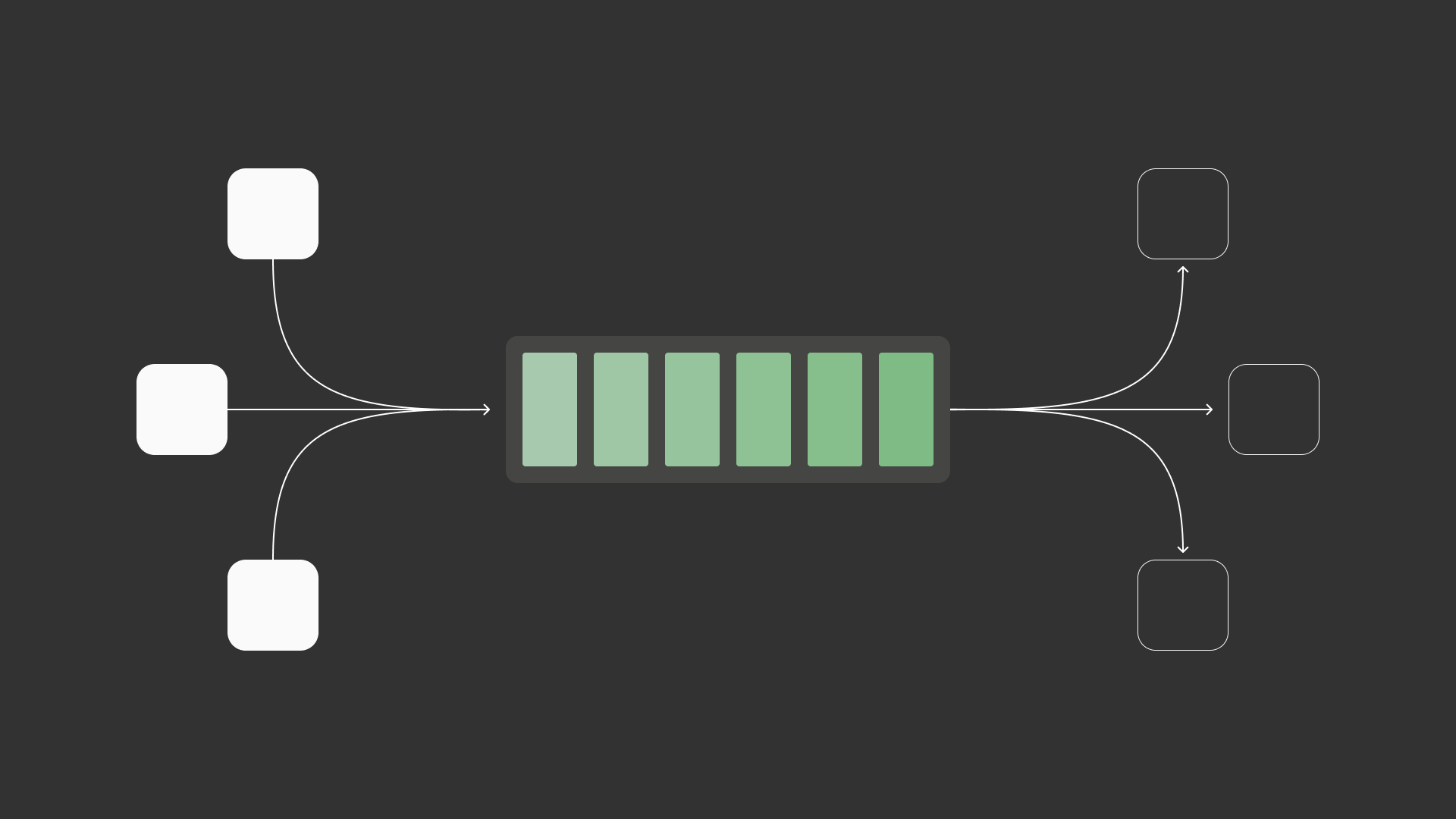
As messaging becomes part of the architecture, different kinds of messages tend to emerge. Some messages represent work that should be handled once, while others signal that something has happened and may be of interest to several parts of the system. Most systems end up using a combination of both.
Messaging also changes how failures appear. When a broker sits between services, retries, delays, and duplicate messages become visible rather than hidden. Systems that handle this well treat these situations as normal behavior rather than exceptions.
Once work moves out of the request–response path, visibility changes as well. In synchronous flows, problems usually surface immediately. With asynchronous messaging, work continues in the background, and issues may show up later. Understanding what is happening in the system becomes more important, and message flow often provides the signals that something is under pressure.
At some point, the choice of broker becomes part of the discussion. Different brokers make different trade-offs around performance, durability, routing, and operational complexity. The right choice often depends on how messaging is used in the system, rather than on features alone.
At CloudAMQP, conversations around asynchronous messaging often involve brokers like RabbitMQ and LavinMQ, which apply the same core messaging concepts in slightly different ways.
The same problems, different use cases, different industries
It’s interesting to see how the same architectural challenges appear again and again, regardless of industry:
- Finance: Banks and financial institutions use message brokers for order processing, payments, and stock trades, where reliability and traceability are essential.
- Retail: Retail systems rely on messaging to handle sudden spikes in traffic, such as large campaigns or sales events, ensuring that orders are processed even under heavy load.
- Healthcare: Hospitals use messaging to securely exchange patient data between systems, for example between registration, billing, and medical records.
- On-demand services: Food delivery and taxi platforms use messaging to coordinate orders, status updates, and real-time events between customers, drivers, and backend systems.
- IoT and infrastructure: Messaging is often used to collect and process data from connected devices, such as sensors in buildings or ventilation systems, where events are produced continuously and need to be handled reliably.
Similar use cases can be found in entertainment, government, manufacturing, and education. In many of these systems, message queuing is not an add-on, but a core part of the architecture.
Moving away from waiting
In distributed systems, moving to asynchronous messaging often means moving away from waiting. In synchronous setups, one slow service can affect many others. By introducing a broker such as RabbitMQ or LavinMQ, services can communicate without depending on each other’s immediate availability.
Traffic spikes, growing latency, or a need to avoid data loss during downtime are often signals that tighter coupling has become a limitation. When one service slows down or becomes unavailable, its impact tends to spread through the system because other services are forced to wait.
I want to hear your story!
Stories from production systems—both what worked and what did not—help others make better decisions earlier. That exchange of experience allows the ecosystem to keep evolving.
I enjoy visiting customers and talking about what has worked and what has not in real systems. Sometimes that takes the form of a workshop, other times it is simply a conversation about how RabbitMQ or LavinMQ is used in practice.
Those conversations often lead to new insights on both sides. If there is a story to share or an architecture worth exploring together, reaching out is always welcome.
 Lovisa Johansson