Building real-time IoT dashboards with LavinMQ and WebSockets
This post is part 3 of the IoT messaging series
Parties in this series:
- Part 1 – Introduction
- Part 2 – Understanding the protocols behind IoT messaging
- Part 3 – Building real-time IoT dashboards with LavinMQ and WebSockets (you are here)
- Part 4 – Visualizing IoT data dynamically through live dashboards
- Part 5 – Securing and scaling IoT systems for reliability and performance
In this post, we’ll explore how to build real-time IoT dashboards using LavinMQ and WebSockets. You’ll learn how LavinMQ enables instant, reliable communication between IoT devices and your web applications - without needing HTTP polling. By the end, you’ll understand how to use WebSockets with MQTT or AMQP to stream live sensor updates directly to any dashboard the moment they are produced.
Many traditional web-based systems, such as dashboards, rely on HTTP polling , where the dashboard repeatedly sends requests for new data, and the server responds with whatever it has. This works for slow-changing data, but it becomes inefficient and unreliable for IoT systems.
This is because:
- IoT devices continuously generate data, sometimes at hundreds of readings per second.
- Polling requests arrive slower than new data is produced. Older readings are often overwritten before the next request arrives, leading to data loss.
- Network and CPU resources are wasted on repeated, unnecessary requests.
To handle IoT workloads efficiently and reliably, you need a system that pushes updates instantly instead of waiting for devices to request them.
LavinMQ is a high-performance message broker that supports both AMQP and MQTT. It acts as a middle layer between IoT devices and consumers, ensuring every message is delivered reliably. What makes LavinMQ especially powerful for real-time IoT systems is its support for AMQP and MQTT over WebSockets. This lets dashboards and applications maintain a persistent, bidirectional connection and receive messages instantly.
Here’s how it works:
- IoT devices publish data to LavinMQ via MQTT or AMQP.
- LavinMQ receives and routes the data.
- Dashboards consume data as soon as it’s available via AMQP or MQTT WebSockets.
The diagram below illustrates the flow 👇

Why WebSockets matter
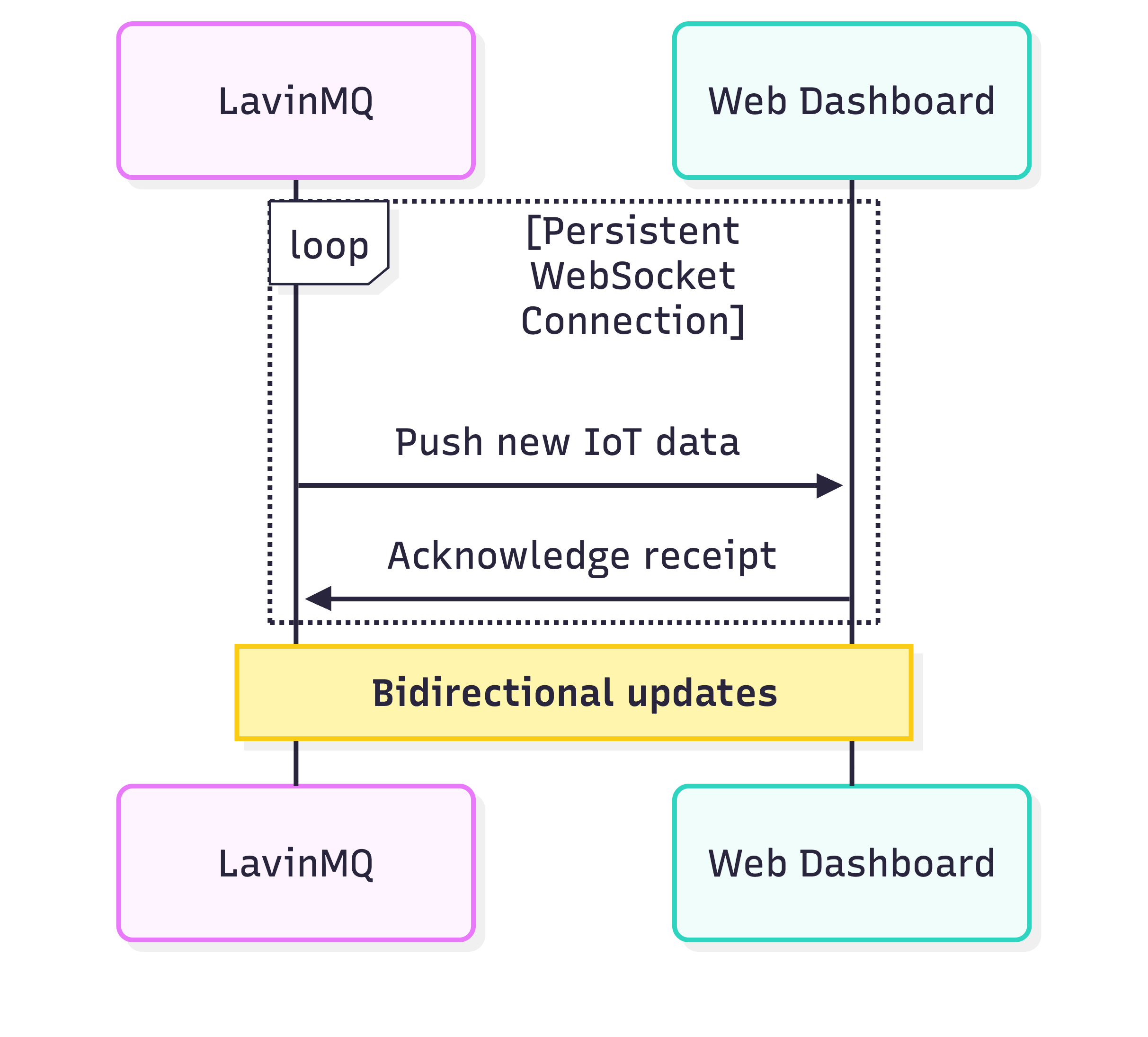
WebSockets create a persistent, full-duplex connection (meaning data can be sent and received at the same time) between LavinMQ and the dashboard.
Once a dashboard connects, it remains connected. This allows LavinMQ to push updates the moment they arrive - no repeated requests, no waiting for the next polling interval.
If a dashboard temporarily disconnects, LavinMQ safely stores messages. When the client reconnects, LavinMQ automatically delivers the stored messages, ensuring no data loss.
The diagram below illustrates the role of WebSockets:
Putting LavinMQ between IoT devices and dashboards for real-time messaging offers several benefits:
- New data flows directly to connected dashboards without delay or manual refresh.
- Devices and dashboards can both send and receive messages through the same channel.
- LavinMQ ensures durability with persistent queues, message acknowledgments, and replay capability.
- Messages survive restarts, network hiccups, or temporary disconnections.
This architecture is ideal for use cases that require fast, continuous communication between devices and services. It works particularly well for live device monitoring, where real-time data needs to be streamed and displayed without delay. It also supports interactive smart-home control panels that rely on immediate command execution. In industrial automation, the setup enables responsive dashboards and smooth coordination between machines. Additionally, it is a strong fit for real-time alerts and analytics, where rapid event processing and instant notifications are essential.
Summary
LavinMQ bridges IoT devices and real-time dashboards through MQTT/AMQP over WebSockets. It ensures continuous data flow, minimizes latency, and guarantees reliable message delivery. Whether you’re building a live IoT dashboard, real-time alerting system, or connected device network, LavinMQ gives you the infrastructure to make it truly instant.
In the next post, we’ll explore how to visualize IoT data dynamically through interactive dashboards.
👉 Next up: Visualize IoT data dynamically through live dashboards
Want to try it yourself?
👉 Check out: Real-time temperature monitoring with LavinMQ.